Guardia Industries
August 2026
Introduction: What Are We Actually Trying to Explain?
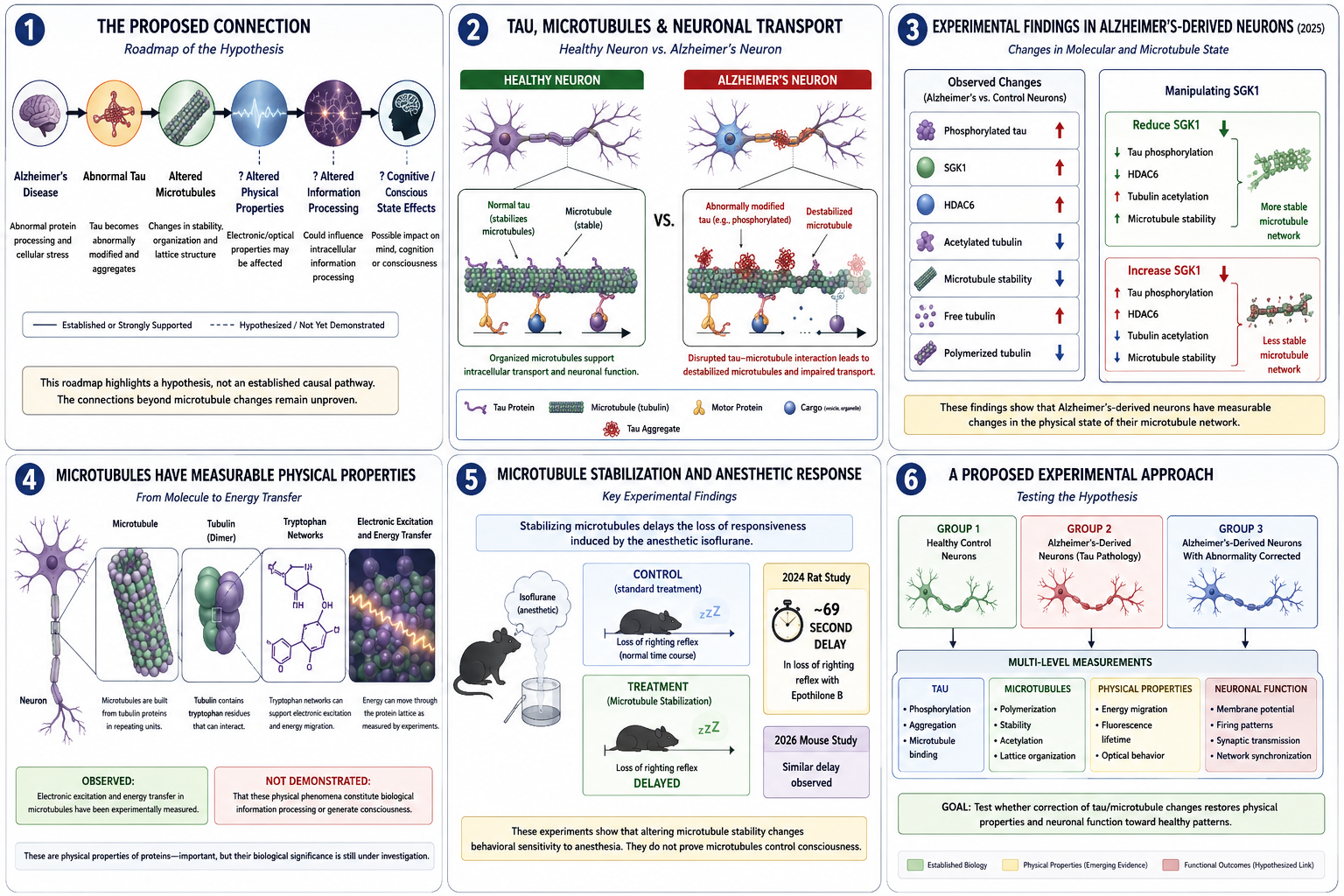
Alzheimer’s disease is characterized by abnormal protein processing and aggregation, particularly involving amyloid-β and tau. Tau pathology is closely associated with neuronal dysfunction, while changes in the microtubule network can impair the internal organization and transport systems on which neurons depend. Exactly how these processes initiate and interact to produce the disease remains unresolved.
This article examines one specific question within that larger problem: could tau-induced changes in neuronal microtubules have consequences beyond the conventional functions of the cytoskeleton, potentially affecting intracellular information processing?
The question is deliberately narrower than a claim that microtubules are the “cause” of Alzheimer’s disease. The evidence reviewed here does not establish such a cause. Instead, it suggests a testable possibility: if tau pathology changes the physical structure and dynamics of microtubules, and if microtubules also possess measurable electronic or optical properties, could those changes influence neuronal function in ways that are not explained entirely by impaired transport?
That distinction is important throughout this article. Some of the biology described below is well established. Some findings are recent but still developing. The possible connection between altered microtubules, unusual physical properties, information processing, and consciousness remains a hypothesis rather than established science.
1. Microtubules: The Neuron’s Internal Framework
Microtubules are hollow protein structures found throughout eukaryotic cells. They are a major component of the cytoskeleton and are built from tubulin proteins. In neurons, microtubules provide structural support and serve as tracks along which molecular motors transport cargo through the cell.
- They help maintain cellular and axonal structure.
- They provide tracks for intracellular transport of vesicles, organelles, and other cargo.
- They participate in cell division in cells that undergo mitosis.
- They form the structural core of cilia and related cellular structures.
Microtubules are therefore not passive scaffolding. They are dynamic structures whose assembly, disassembly, modification, and interactions with other proteins are regulated by the cell.
2. Tau and the Microtubule Network in Alzheimer’s Disease
Tau is a microtubule-associated protein. In healthy neurons, tau interacts with microtubules and helps regulate their organization and dynamics, particularly in axons.
In Alzheimer’s disease and related tauopathies, tau undergoes abnormal post-translational modifications, including abnormal phosphorylation. Pathological tau can lose its normal relationship with microtubules, form abnormal oligomers and aggregates, and become associated with neuronal dysfunction.
A simplified description of the established relationship is:
Normal state:
Tau → interacts with microtubules → regulates microtubule stability and dynamics → supports neuronal structure and transport
Pathological state:
Abnormal tau modification → altered tau–microtubule interaction → disrupted microtubule organization and dynamics → impaired neuronal function
This does not mean that tau tangles simply “block transport and kill neurons.” The biology is more complicated. Tau pathology, microtubule dysfunction, impaired transport, synaptic dysfunction, inflammation, and other disease processes interact over time. Nevertheless, the relationship between tau pathology and microtubule dysfunction is an important and well-supported part of Alzheimer’s biology.
3. Recent Evidence: Alzheimer’s-Derived Neurons Show Microtubule Changes
Recent work using cortical neurons derived from patient-induced pluripotent stem cells provides a more direct look at the physical state of the neuronal microtubule network.
In the 2025 study discussed here, Alzheimer’s-derived neurons showed several changes compared with control neurons, including:
- increased phosphorylated tau
- increased SGK1
- increased HDAC6
- reduced acetylated tubulin
- reduced microtubule stability
- increased free tubulin
- reduced polymerized tubulin
The significance of these findings is that the Alzheimer’s-derived neurons were not simply accumulating abnormal tau. Their microtubule network showed measurable changes in its physical state.
The researchers also manipulated SGK1, a kinase involved in cellular stress responses. Reducing SGK1 was associated with reduced tau phosphorylation and HDAC6, increased tubulin acetylation, and increased microtubule stability. Increasing SGK1 produced the opposite pattern.
These findings support a mechanistic relationship among cellular stress, SGK1, tau phosphorylation, HDAC6, tubulin acetylation, and microtubule stability. They do not, however, establish a single simple linear sequence in which every step necessarily occurs in that order.
This distinction matters. The evidence supports the idea that microtubule dysfunction can be an active component of Alzheimer’s neuronal pathology rather than merely a passive consequence of neurons dying.
4. The Question Beyond Transport
The conventional explanation for why microtubule disruption matters is already compelling: neurons depend heavily on microtubules for intracellular transport and structural organization. If that system becomes unstable, axonal transport and synaptic function can suffer.
But microtubules are physical structures at molecular dimensions. That raises a second question: do changes in their organization also change physical properties that could matter to neuronal signaling or information processing?
This is where a separate area of research becomes relevant.
5. Microtubules and Electronic Energy Transfer
Experimental work has reported electronic excitation energy transfer through networks of tryptophan residues associated with tubulin and microtubules. In one 2023 study, anesthetic compounds including isoflurane and etomidate reduced the measured energy migration.
This is an interesting physical result, but it needs to be interpreted carefully.
The experiment demonstrates a measurable electronic energy-transfer phenomenon. It does not demonstrate that microtubules process thoughts, store memories, or generate consciousness. Nor does it establish that the phenomenon is responsible for any particular function of the brain.
At this point there are three separate propositions:
- Microtubules have measurable molecular and electronic properties. This is experimentally accessible.
- Some anesthetic molecules can alter particular physical properties associated with microtubules. This has experimental support.
- Those properties constitute a mechanism of consciousness. This has not been demonstrated.
Keeping those three propositions separate is essential to evaluating the hypothesis.
6. The Anesthesia Connection
The connection becomes more interesting when microtubules are manipulated in intact animals.
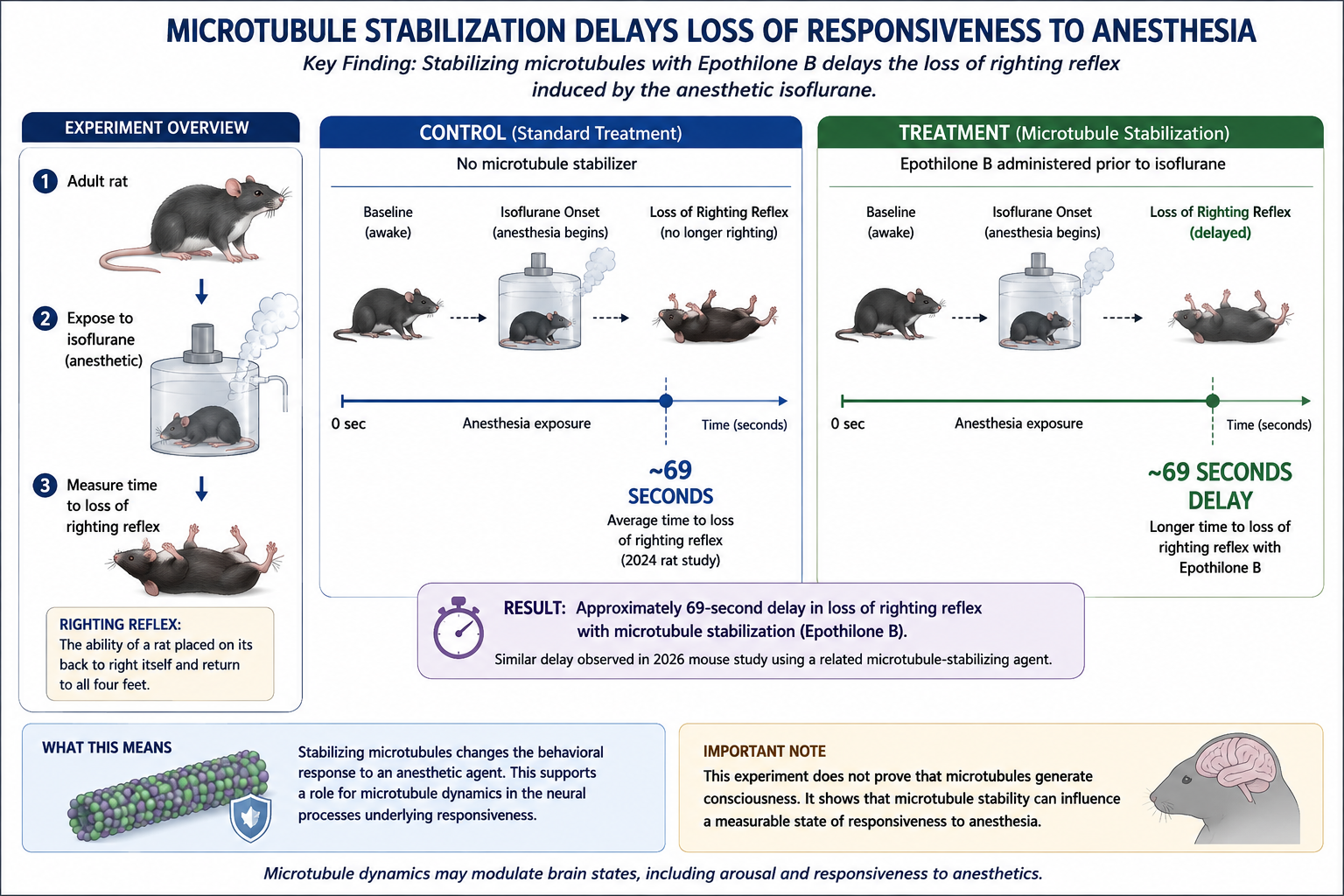
In a 2024 rat study, animals treated with epothilone B, a microtubule-stabilizing drug, took longer to lose the righting reflex after exposure to isoflurane. The difference was approximately 69 seconds. A 2026 mouse study similarly reported that brain-penetrant epothilone B delayed loss of the righting reflex under isoflurane.
These experiments are important because they move beyond a purely theoretical discussion. They show that altering microtubules can change an animal’s behavioral response to an anesthetic.
However, the correct conclusion is narrower than “microtubules cause consciousness.” Loss of the righting reflex is a commonly used behavioral measure of anesthetic-induced unconsciousness, but changing the response to an anesthetic does not by itself identify the cellular mechanism responsible for consciousness.
Microtubule stabilization can affect many aspects of neuronal biology, including transport, structural organization, signaling, and synaptic function. Therefore, these experiments establish an important association and possible causal contribution, but they do not establish that a quantum mechanism is responsible.
A scientifically cautious conclusion is:
Microtubule manipulation can alter susceptibility to anesthetic-induced loss of behavioral responsiveness. The mechanism responsible for that effect remains an open question.
7. Bringing the Two Research Areas Together
We can now place the two sets of observations beside each other.
Alzheimer’s research:
Tau pathology → altered tau–microtubule interaction → changes in microtubule stability and organization → impaired neuronal function
Microtubule/anesthesia research:
Microtubule manipulation → altered response to anesthetic exposure → altered latency to loss of behavioral responsiveness
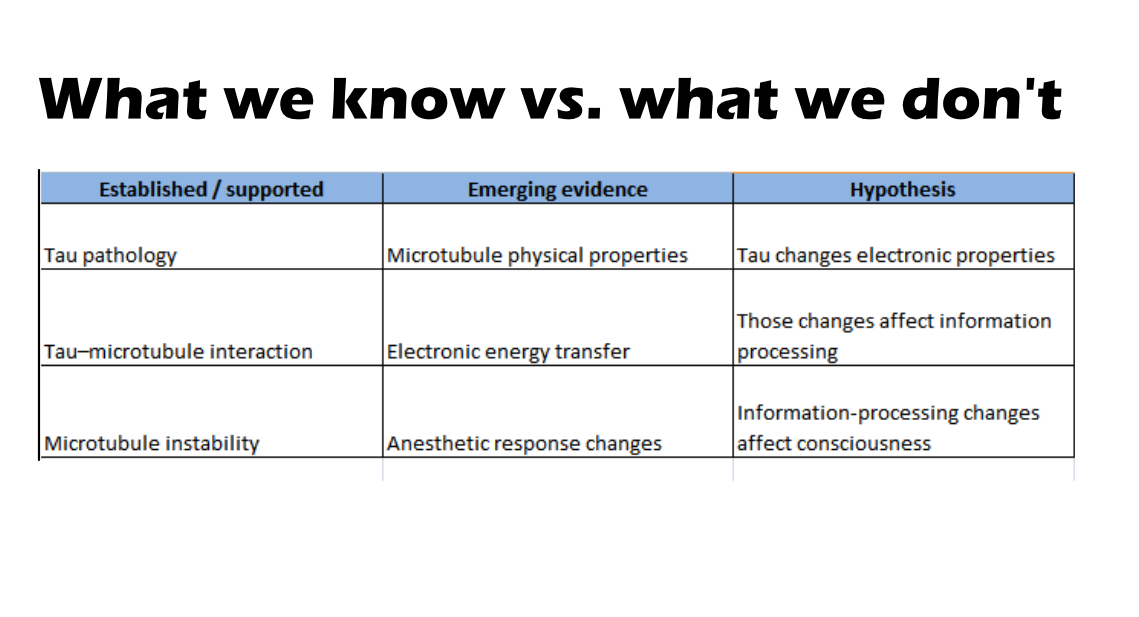
These findings intersect at the microtubule, but they do not yet form one demonstrated causal pathway.
The missing link is the crucial one:
Does tau-induced alteration of the microtubule lattice change any physical property that is relevant to neuronal information processing, and if so, does that change contribute to cognitive or conscious-state dysfunction?
8. Tau Interacts With the Microtubule Architecture
Recent structural work provides another reason to investigate this question. Tau does not merely exist near microtubules as an independent molecule. It interacts physically with the microtubule lattice and can influence microtubule dynamics.
This makes it reasonable to ask whether pathological changes in tau could alter aspects of the microtubule structure itself, including stability, dynamics, organization, and interactions with other proteins.
A further step, however, is speculative: if some electronic or optical property depends on the organization of the tubulin lattice, then a change in that organization might also change that property.
That last statement is a hypothesis. It should not be presented as an established consequence of tau pathology.
The experimentally important question is therefore not simply whether tau changes microtubules. We already have evidence that it does. The question is whether those structural and dynamic changes alter a measurable physical property that has a functional consequence for neurons.
9. What Does “Quantum” Actually Mean Here?
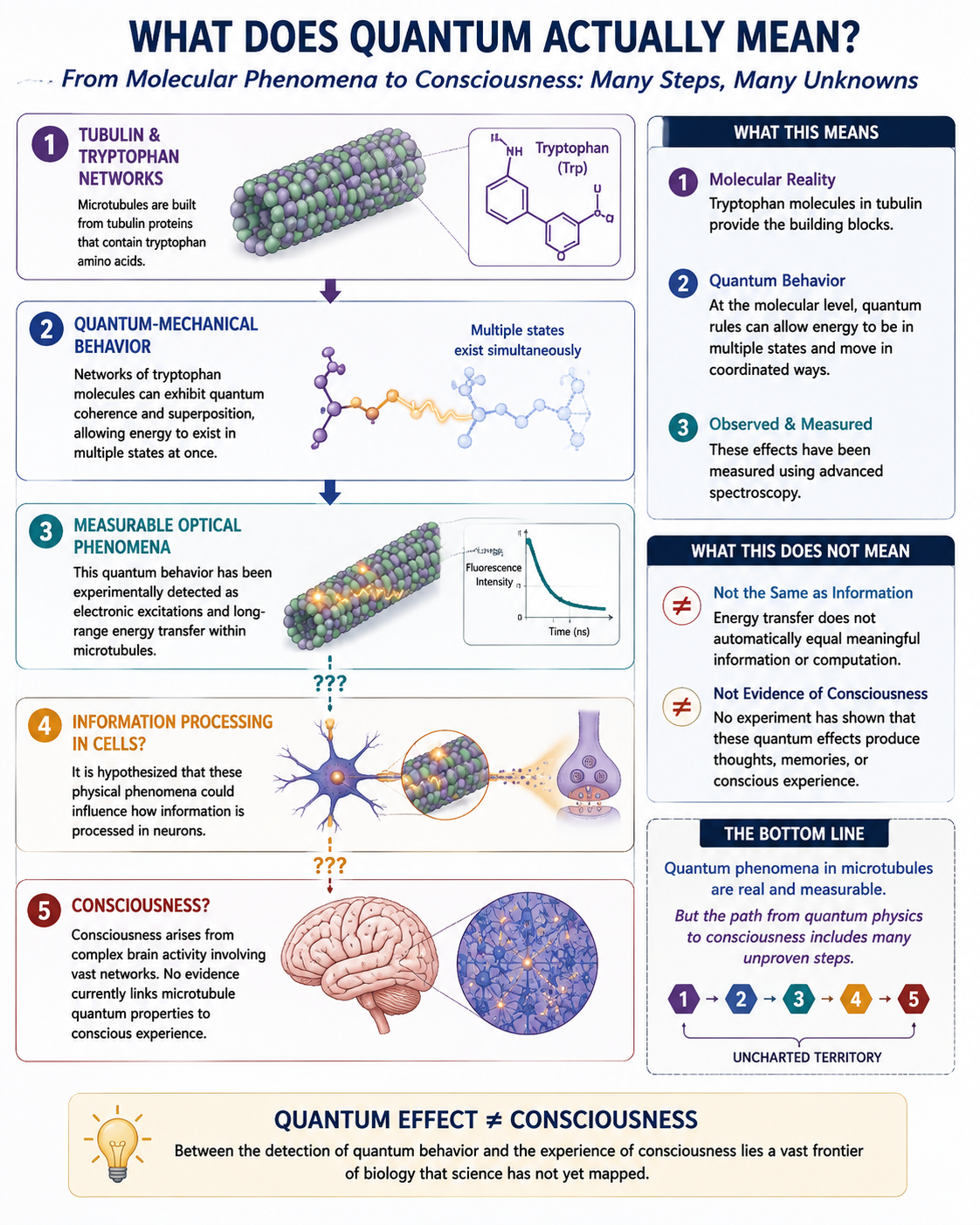
The word “quantum” needs particular care in this discussion. Molecular systems obey quantum mechanics, but observing a quantum-mechanical or quantum-optical phenomenon does not automatically make that phenomenon biologically important.
Research involving tryptophan networks and protein assemblies has reported collective optical behavior, including superradiance under experimentally accessible conditions. Such findings are scientifically interesting because they show that organized biological molecules can display collective physical behavior.
But:
Superradiance ≠ consciousness.
A measurable quantum-optical phenomenon does not demonstrate that the phenomenon carries thoughts, memories, self-awareness, or subjective experience.
For a quantum-based consciousness hypothesis to become scientifically persuasive, researchers would need to establish a causal sequence connecting a particular physical phenomenon to neuronal information processing and ultimately to a measurable state of consciousness.
10. A Testable Experiment
The most useful next step is not to argue philosophically about whether microtubules are involved in consciousness. It is to design experiments that can separate established biology from the proposed additional mechanism.
One possible experiment would use three groups of human-derived neurons:
- Group 1: healthy control neurons.
- Group 2: Alzheimer’s patient-derived neurons with tau pathology.
- Group 3: Alzheimer’s-derived neurons in which the relevant tau or microtubule abnormality has been experimentally corrected.
The measurements should be made at several levels.
Tau:
- phosphorylation
- aggregation or oligomerization
- microtubule binding
Microtubules:
- polymerization
- stability
- tubulin acetylation
- lattice organization
- dynamic instability
Physical properties:
- electronic energy migration
- fluorescence lifetime
- collective optical behavior
- other measurable electromagnetic or quantum-optical properties
Neuronal function:
- membrane potential
- neuronal firing
- synaptic transmission
- network synchronization
- other measures of information processing
The first question would be straightforward: does correcting the microtubule abnormality improve neuronal function?
That alone would be valuable and would extend our understanding of Alzheimer’s pathology.
The more speculative question would be whether correction also restores a specific physical property that has been independently linked to neuronal information processing or conscious state.
11. The Critical Control: Separate Microtubule Effects From General Neuronal Health
An especially important experiment would compare neurons with similar degrees of general neuronal damage but different microtubule states.
For example:
- Neuron A: relatively normal microtubules.
- Neuron B: destabilized microtubules.
- Neuron C: stabilized microtubules.
The critical point is that these groups would need to be carefully matched for cell viability and other measures of neuronal health. Otherwise, a difference in physical or information-processing properties could simply reflect the fact that one group is healthier than another.
Researchers could then ask whether the proposed microtubule-dependent physical properties change before neuronal death and whether those changes predict measurable differences in neuronal information processing.
The strongest evidence would come from experiments in which the physical property can be manipulated independently of general neuronal health and in which the resulting change produces a predictable functional effect.
12. What Evidence Would Change the Hypothesis?
Four levels of evidence would be particularly important.
Evidence 1 — Alzheimer’s microtubules differ.
This has already been demonstrated in several forms, including altered microtubule stability, tubulin acetylation, free versus polymerized tubulin, and abnormal tau association.
Evidence 2 — Those microtubule changes affect something beyond transport.
For example, researchers would need to demonstrate an effect on a measurable aspect of neuronal information processing that cannot be explained entirely by conventional transport or structural dysfunction. Some relevant evidence is emerging, but this remains incomplete.
Evidence 3 — The proposed property correlates with conscious state rather than simply neuronal health.
This has not been demonstrated.
Evidence 4 — Manipulating that property changes conscious state.
This would be the strongest evidence. Ideally, the manipulation would change the proposed mechanism without simply killing neurons, broadly exciting them, or otherwise disrupting ordinary brain function.
This final level is the major missing experiment.
13. What We Can Say Now
Several conclusions can be stated with reasonable confidence.
First, abnormal tau is an important feature of Alzheimer’s disease and is closely associated with disruption of neuronal microtubule biology.
Second, Alzheimer’s-derived neurons can show measurable changes in microtubule stability, tubulin acetylation, and the balance between free and polymerized tubulin.
Third, microtubules possess measurable molecular and electronic properties, including experimentally observed energy-transfer behavior.
Fourth, pharmacologically altering microtubules can change an animal’s response to anesthetic-induced loss of behavioral responsiveness.
What has not been demonstrated is that these observations form a single mechanism connecting Alzheimer’s pathology to consciousness.
In particular, we do not yet know whether tau-induced changes in microtubule structure alter electronic or quantum-optical properties in living neurons in a way that affects information processing, cognition, or conscious state.
14. The Central Hypothesis
The question can therefore be stated precisely:
Could tau-induced changes in the physical state of neuronal microtubules contribute not only to neuronal degeneration and impaired transport, but also to changes in cellular information processing?
And, if such information-processing effects exist, could they contribute to some of the progressive cognitive and conscious-state changes associated with Alzheimer’s disease?
At present, these are testable hypotheses rather than established facts.
15. Cognition Is Not the Same as Consciousness
One final distinction is essential. Alzheimer’s disease does not simply produce a binary transition from consciousness to unconsciousness. The disease progressively disrupts memory, recognition, attention, executive function, language, orientation, self-related processing, and interaction with the environment.
A severe memory deficit is not equivalent to loss of consciousness, and the cognitive deterioration associated with Alzheimer’s is neurologically different from the anesthetic-induced state of unconsciousness.
If microtubules eventually prove to contribute to consciousness, that does not mean every cognitive symptom of Alzheimer’s is caused by a microtubule-based consciousness mechanism.
A useful research program should therefore distinguish among three possible claims:
- Microtubule dysfunction contributes to ordinary neuronal and cognitive impairment.
- Microtubule-dependent processes contribute to specific components of conscious processing.
- Microtubules constitute a fundamental physical substrate of consciousness.
The first is compatible with substantial existing evidence. The second is an open research question. The third remains a much stronger and more speculative hypothesis.
Conclusion
The most interesting aspect of current Alzheimer’s research may not be the discovery of a single new cause, but the possibility of connecting several levels of biology that are usually studied separately.
At one level, tau pathology alters the neuronal microtubule system. At another, microtubules exhibit measurable physical properties beyond their familiar role as cellular scaffolding and transport tracks. Separately, experimental manipulation of microtubules can change sensitivity to anesthetic-induced loss of behavioral responsiveness.
Those observations intersect at the same biological structure, but they do not yet prove a common mechanism.
The scientifically useful question is therefore not whether “quantum microtubules cause Alzheimer’s.” The evidence does not support that statement.
The more precise question is this:
Could tau-induced changes in the physical state of neuronal microtubules alter properties involved in intracellular information processing, and could those changes contribute to the progressive disruption of cognition or conscious-state function in Alzheimer’s disease?
That remains unproven. But it is experimentally testable.
The next step is not to assume the answer. It is to measure the relevant physical properties in healthy and Alzheimer’s-derived neurons, manipulate tau and microtubule states independently where possible, measure neuronal information processing, and determine whether any observed physical changes predict functional or behavioral outcomes.
If such a connection were demonstrated, it would provide a new level of understanding of how molecular pathology can affect neuronal function. If it were not demonstrated, the experiments would still clarify the role of microtubules in Alzheimer’s disease.
Either result would be scientifically valuable.
For now, the appropriate conclusion is one of cautious curiosity: abnormal microtubule behavior is clearly part of Alzheimer’s pathology, unusual physical phenomena can occur within microtubular protein structures, and microtubule manipulation can influence anesthetic responsiveness. Whether these observations are connected to a deeper mechanism of information processing or consciousness remains one of the questions still waiting for an experiment.