If your adhesive tape won’t stick to polypropylene, polyethylene, EVA foam, powder-coated metal, or other difficult surfaces, you’re likely dealing with a low surface energy (LSE) substrate. Choosing the correct tape can mean the difference between a permanent bond and field failures. This guide explains why tapes fail, how to identify challenging materials, and which tape constructions provide the most reliable results.
Selecting the right double-sided adhesive tape often seems straightforward—until the tape fails. Whether you’re bonding plastics, powder-coated metals, foams, or painted surfaces, choosing the wrong tape can lead to production delays, warranty issues, and costly redesigns.
When we troubleshoot failed bonding applications, we find that nearly 85% of tape failures can be traced to just three conditions. The remaining failures are typically caused by poor surface preparation, insufficient application pressure, or changes in material formulations or contamination that affect an adhesive that previously worked well.
Understanding these three primary causes allows engineers, project managers, and purchasing professionals to solve most bonding problems before they reach production.
The Three Most Common Reasons Tape Fails
Nearly every difficult bonding application falls into one of these categories:
- Low surface energy (LSE) materials
- Applying the tape outside its recommended application or service temperature
- Rough or textured surfaces
Let’s examine each of these conditions and the solutions available.
Low Surface Energy Materials
Low surface energy materials are among the most challenging substrates for pressure-sensitive adhesives. Simply put, the adhesive cannot make enough intimate contact with the surface to develop a strong bond.
A simple way to visualize this is to think about washing your car.
An older, unwaxed car allows water to spread across the hood. After waxing, the water beads into small droplets and quickly rolls away. The wax has lowered the surface energy, making it difficult for water to wet the surface.
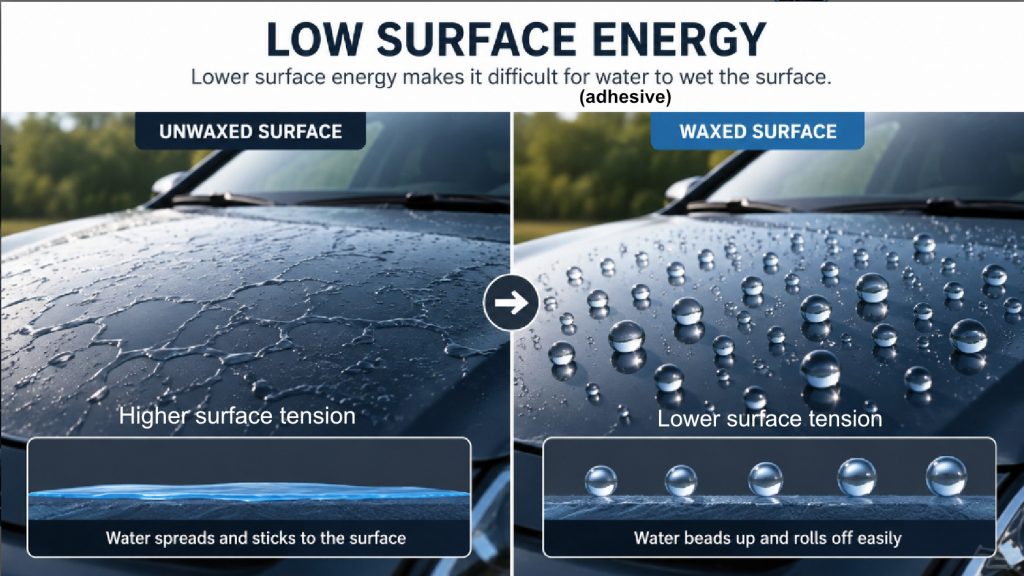
Adhesive behaves in much the same way. It bonds much more effectively to the unwaxed surface because it can spread and make greater contact. On a low surface energy surface, the adhesive cannot fully wet the substrate, resulting in a weaker bond.
Many materials are assigned a Dynes value that indicates their surface energy. Lower Dynes values generally indicate more difficult bonding surfaces. Keep in mind, however, that paints, hard coats, and other surface treatments can significantly change a material’s effective surface energy.
Temperature Matters More Than Many Realize
Another common reason for adhesive failure has nothing to do with the tape itself.
Every industrial tape is designed to operate within two temperature ranges:
- Application temperature — the temperature at which the tape should be applied.
- Service temperature — the temperature range in which the bond performs after the adhesive has properly settled or cured.
Below is taken from 3M data sheet
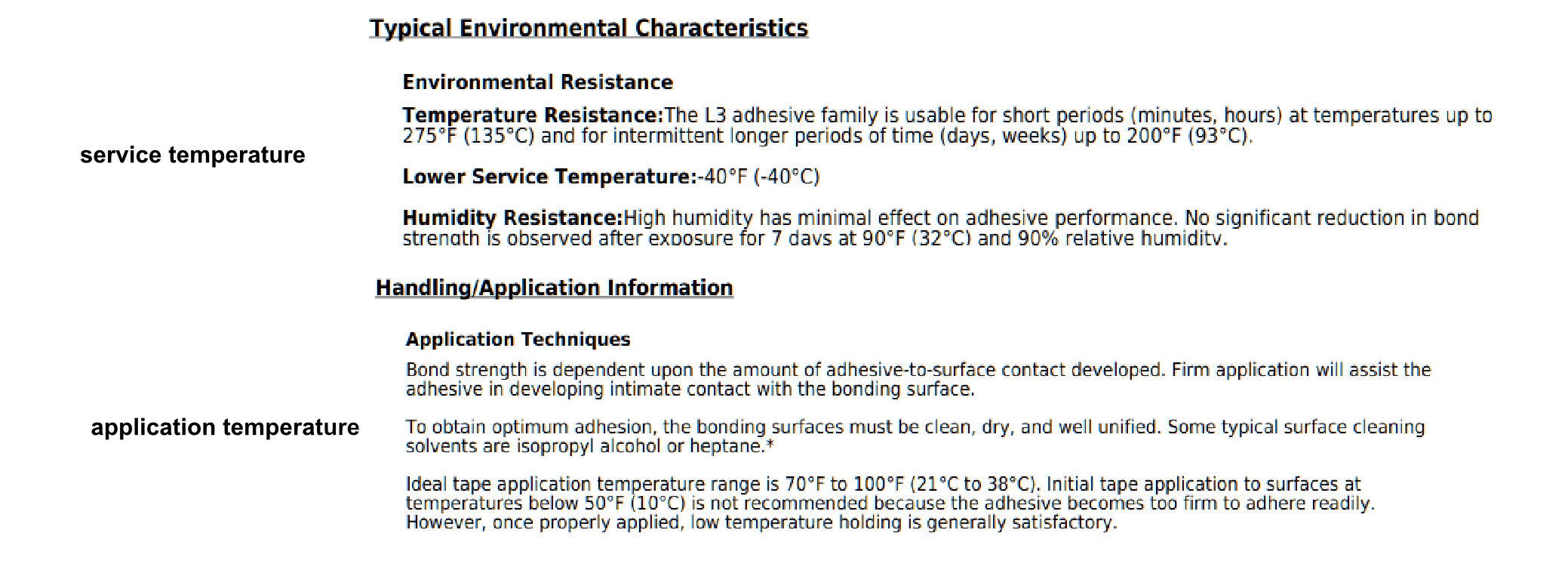
Customers often report that a tape they’ve successfully used for years suddenly begins failing. In many cases, colder application temperatures are the primary cause.
Whenever possible, apply tape within the manufacturer’s recommended application temperature. If colder conditions cannot be avoided, warming the tape—and ideally the substrate—can significantly improve bond performance. If that isn’t practical, consult your tape supplier for products specifically designed for low-temperature application.
Rough and Textured Surfaces
Textured surfaces create a different challenge.
Instead of poor surface chemistry, the problem is incomplete physical contact. Adhesive cannot fully reach into the valleys and irregularities of the surface, reducing the available bonding area.
For these applications, thicker adhesive constructions—particularly foam tapes—often provide the best solution. As pressure is applied, the foam allows the adhesive to conform to the surface profile and increase contact area.
When You Need an LSE Tape
Once you’ve identified low surface energy as the cause of a bonding problem, the next step is selecting an adhesive specifically engineered for these substrates.
These products are commonly referred to as LSE tapes.
Not all LSE tapes perform equally. While many manufacturers offer products designed for low surface energy plastics, performance varies considerably between adhesive formulations.
Among industrial adhesive manufacturers, 3M’s 300LSE family has established a strong reputation for consistently bonding many difficult-to-adhere materials that challenge conventional acrylic adhesives.
Choosing the Right Tape Construction
Selecting the proper adhesive is only part of the solution. The construction of the tape also affects performance, handling, and long-term reliability.
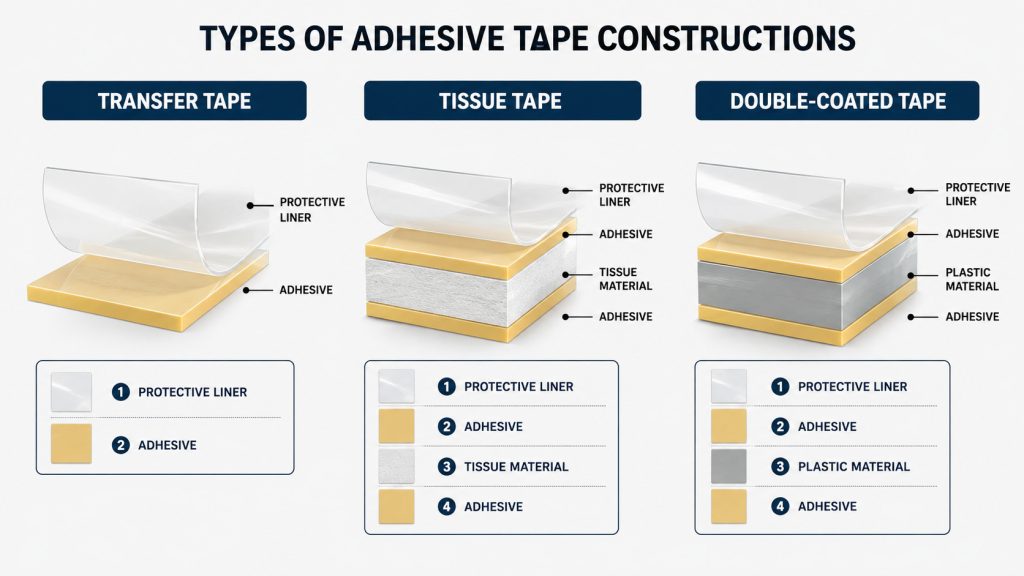
Transfer Tape
Transfer tape consists of adhesive carried on a release liner without an internal supporting carrier.
Its advantages include:
- Extremely thin bond lines
- Excellent conformability around curves
- Long roll lengths for automated dispensing
- Lower material cost
Because the adhesive itself provides all of the strength, transfer tapes are generally best suited for packaging applications and assemblies that experience relatively low mechanical stress.
Tissue Tape
Tissue-supported tapes add a lightweight internal carrier (tissue) that improves handling while maintaining good flexibility and conformability.
These tapes are frequently selected for packaging applications where easier processing is desired without sacrificing flexibility.
Film-Supported Double-Sided Tape
Film-supported double-sided tapes include a polymer film between two adhesive layers.
This construction offers the greatest versatility because manufacturers can use different adhesive chemistries or thicknesses on each side of the tape. For example, one side may use silicone adhesive while the opposite side uses acrylic adhesive, allowing the tape to bond two very different materials.
For many industrial assemblies, film-supported tapes provide the best balance of strength, handling, and design flexibility.
Common Materials Requiring LSE Adhesives
Materials with surface energies below approximately 40 dynes/cm are generally considered difficult to bond.
Examples include:
- PTFE (Teflon) ~18 dynes/cm
- Silicone rubber ~20-24 dynes/cm
- Polypropylene (PP) ~29 dynes/cm
- Polyethylene (PE) ~31 dynes/cm
- EVA foam ~33 dynes/cm
- Polystyrene ~36 dynes/cm
- Powder-coated metals ~36-45 dynes/cm
- EPDM foam ~32-72 dynes/cm (untreated to treated)
- Neoprene foam ~30-45 dynes/cm untreated to treated)
It is important to note that even LSE tapes typically do not bond effectively to PTFE or silicone rubber.
Typical Industrial Applications
LSE tapes are widely used throughout manufacturing because they simplify assembly while providing reliable long-term performance.
Common applications include:
Gaskets and Seals
- Dust and moisture sealing
- Environmental enclosures
- Clean-room doors
- Outdoor electrical cabinets
Electronic Assemblies
- Display mounting
- Touchscreen support
- Camera module positioning
- Acoustic sealing around speakers and microphones
Shock and Vibration Control
Foam-backed LSE tapes help absorb impact, isolate vibration, and compensate for manufacturing tolerances without requiring expensive component redesigns.
Powder-Coated and Painted Metals
Powder-coated finishes are durable and attractive but frequently present bonding challenges for conventional adhesives.
Decorative trim, equipment housings, metal panels, and nameplates often benefit from an LSE adhesive specifically designed for coated metal surfaces.
Likewise, anodized aluminum sits near the boundary between standard and low surface energy materials. Choosing an LSE tape often provides additional design margin and long-term reliability.
Final Thoughts
Successful bonding begins with identifying the actual cause of failure—not simply selecting a stronger adhesive.
In most applications, tape failure results from one of three conditions: low surface energy materials, improper application temperature, or rough surface texture. Once these conditions have been identified, selecting the proper adhesive family and tape construction becomes much more straightforward.
By understanding both the substrate and the application environment, engineers, purchasing professionals, and project managers can reduce trial-and-error testing, improve manufacturing consistency, and select adhesive tapes that deliver reliable long-term performance.
In our next article, we’ll compare the major products in the 3M 300LSE family and discuss which tape is best suited for specific industrial applications.