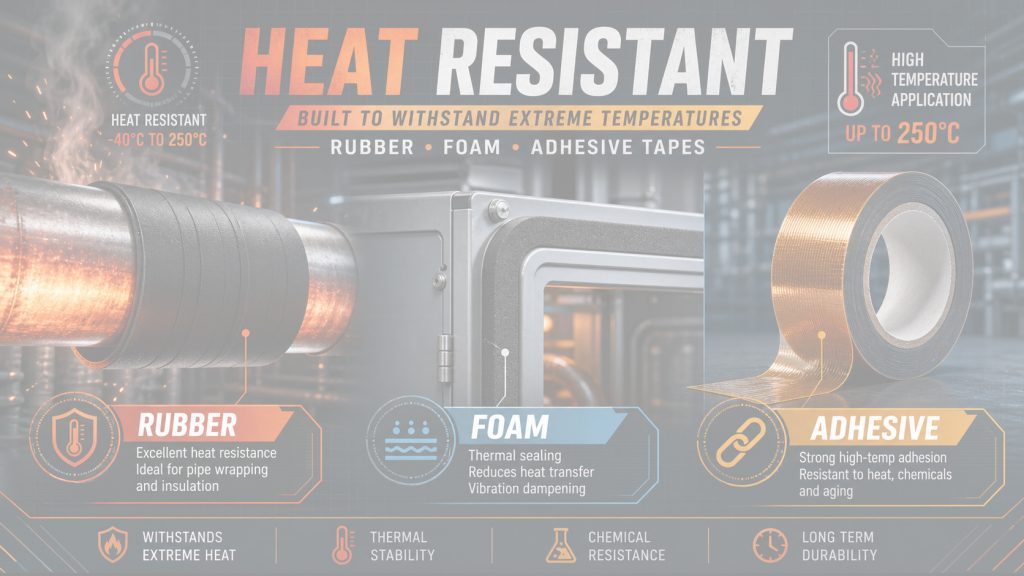
Heat is one of the leading causes of premature failure in industrial assemblies. Elevated temperatures can reduce adhesive performance, degrade rubber components, distort plastics, and shorten the service life of equipment. Whether you’re designing a new product or improving an existing assembly, selecting materials that withstand both operating temperatures and environmental conditions is critical to long-term reliability.
This guide reviews several of the most commonly used industrial rubber and foam materials, explains where each performs best, and recommends compatible double-sided adhesive tapes for high-temperature applications.
Common Sources of Heat in Industrial Assemblies
High temperatures can originate from many sources, including:
Mechanical Sources
- Electric motors operating under normal or heavy loads
- Friction generated by moving components
- Vibration created by motors or rotating equipment
Environmental Sources
- Furnaces, boilers, and welding operations
- Poor ventilation that traps heat within an enclosure
- Direct sunlight or heat lamps
- Elevated temperatures during storage or transportation
Electrical Sources
- High electrical current
- Rapid switching or cycling of electrical components
Understanding where heat originates is the first step toward selecting materials capable of maintaining long-term performance.
Heat-Resistant Rubber and Foam Materials
The following temperature ranges are typical operating limits and may vary depending on manufacturer formulations.
Material | Typical Temperature Range |
Silicone | 400–500°F (204–260°C) |
Fluorosilicone | 400–450°F (204–232°C) |
EPDM | Up to 400°F (204°C) |
Nitrile (Buna-N) | Up to 300°F (149°C) |
Neoprene | Up to 300°F (149°C) |
Natural Rubber | Up to 250°F (121°C) |
Cross-linked Polyethylene (XLPE) | 200–300°F (93–149°C) |
Silicone Rubber
Silicone rubber offers the highest continuous temperature resistance of the materials covered in this guide. It also provides excellent resistance to UV exposure, ozone, chemicals, and many oils, making it an outstanding choice for demanding industrial environments.
Typical applications include:
- High-temperature gaskets
- Cushioning
- Heat shields
- Sealing applications
One of silicone rubber’s greatest advantages is its excellent compression set resistance, allowing it to recover its original shape after prolonged compression.
Silicone Sponge vs. Silicone Foam
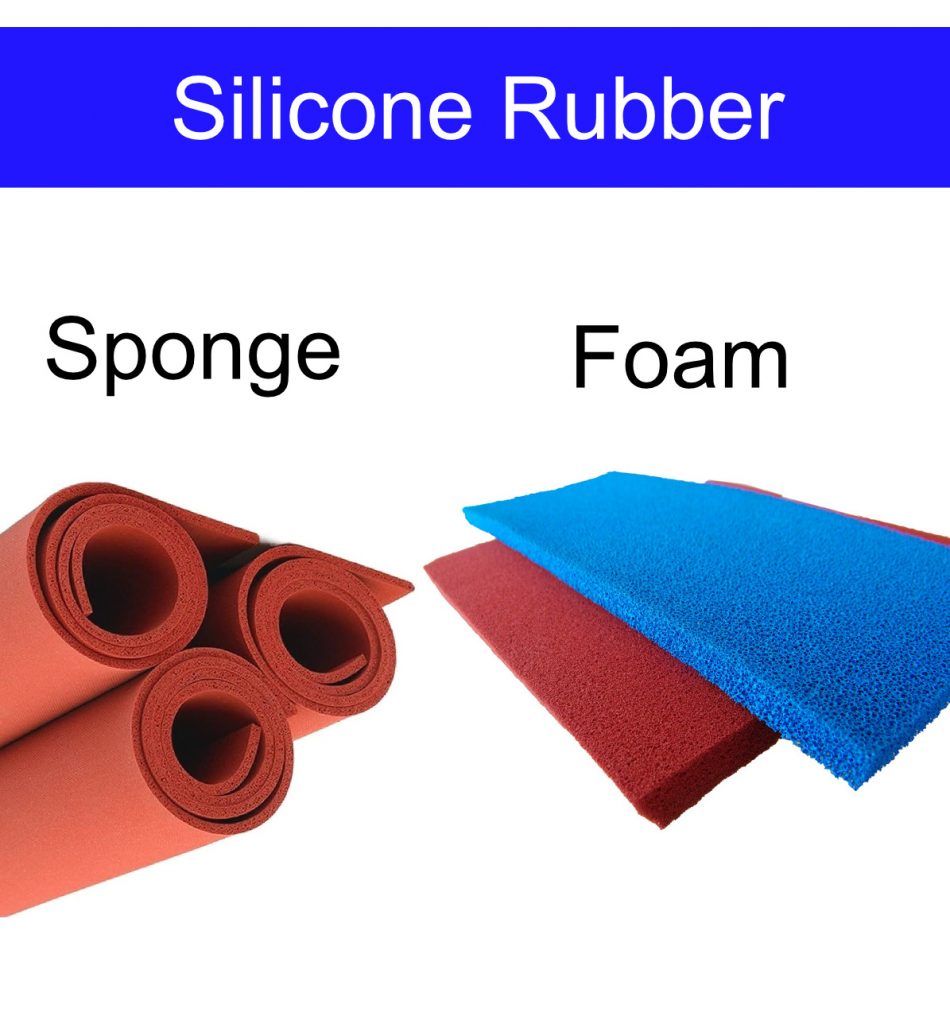
Although both are expanded silicone elastomers, they serve different purposes.
Silicone Sponge
- Closed-cell construction
- Prevents air and liquid penetration
- Best for outdoor sealing, liquid sealing, and dust protection
- Operating range: -100°F to +500°F (-73°C to +260°C)
Silicone Foam
- Open-cell construction
- Lower density
- More compressible
- Ideal for lightweight sealing and flame-rated applications
- Operating range: -67°F to +392°F (-55°C to +200°C)
Choosing the Right Adhesive Tape for Silicone
Silicone rubber has extremely low surface energy, making it one of the most difficult materials to bond.
Silicone adhesive transfer tapes are available with either silicone adhesive on both sides or silicone adhesive on one side and acrylic adhesive on the other.
A silicone adhesive on both sides provides maximum heat resistance, typically between 400°F and 500°F (204°C to 260°C). However, when one bonding surface is metal or plastic rather than silicone rubber, overall bond strength may be reduced.
For mixed-material assemblies, a silicone/acrylic construction often performs better. For example, 3M 9731 combines a silicone adhesive with 3M’s Acrylic 350 adhesive, providing excellent adhesion to metals, plastics, and many low-surface-energy materials while maintaining high-temperature performance.
The acrylic adhesive provides short-term heat resistance to approximately 480°F (232°C) and continuous exposure up to 300°F (149°C).
Fluorosilicone
Fluorosilicone is a modified silicone rubber designed to improve resistance to fuels and petroleum-based fluids.
Typical applications include:
- Aircraft fuel systems
- Automotive fuel emission systems
- Petroleum oil environments
- Chlorinated solvent exposure
While fluorosilicone excels in chemical resistance, it does not perform as well as standard silicone in prolonged exposure to hot air or gases.
Because fluorosilicone also exhibits very low surface energy, pressure-sensitive adhesives generally require surface treatment before achieving reliable adhesion. Otherwise, an RTV adhesive may be a better solution.
EPDM Rubber
EPDM is one of the most widely used industrial elastomers because of its excellent weather resistance and versatility.
Common applications include:
- Outdoor gaskets
- Weather seals
- Transportation
- Automotive components
- Electronics
- Aviation
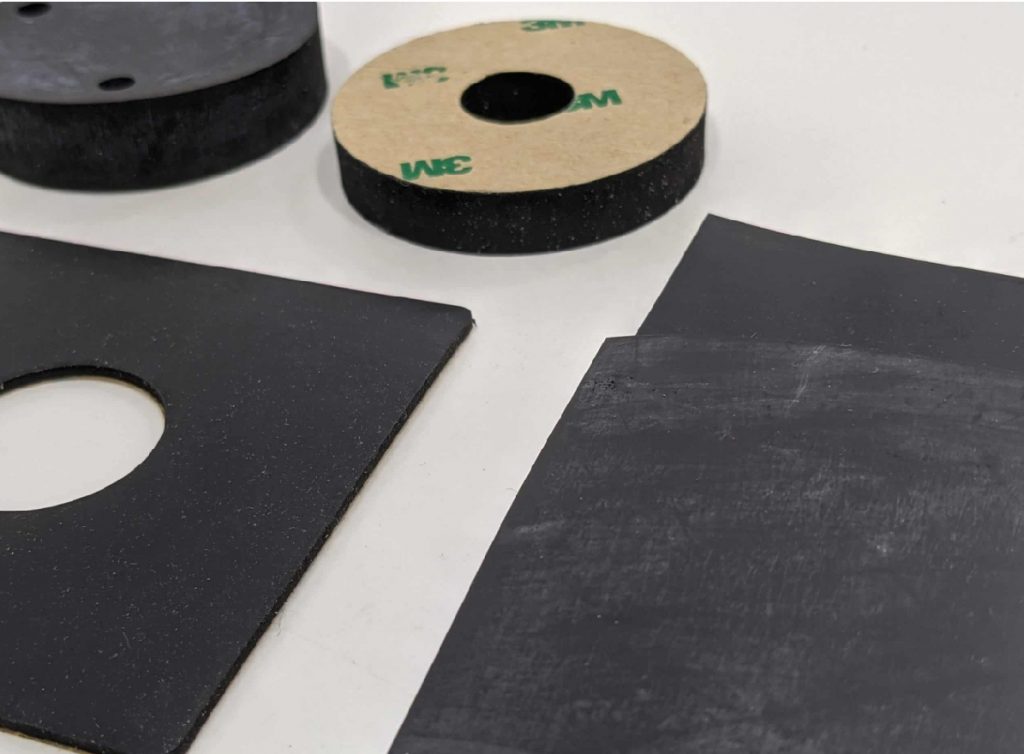
EPDM is frequently blended with other elastomers, such as SBR, for weather stripping and low-pressure sealing applications. Fire-rated EPDM formulations are also available for applications requiring UL compliance.
Open-cell EPDM provides excellent compressibility for sealing applications, while closed-cell EPDM is better suited for vibration damping and environmental sealing.
One limitation is poor resistance to petroleum oils, fuels, and many solvents.
Recommended Adhesive
Because EPDM generally has low surface energy, 3M’s 300LSE adhesive family is an excellent choice.
When higher temperature capability is required, 3M 200MP products such as 467MP and 468MP provide greater heat resistance. However, these adhesives are not specifically designed for low-surface-energy substrates, so the EPDM surface should first be treated to increase surface energy before bonding.
Nitrile (Buna-N)
Nitrile rubber is the preferred material when resistance to petroleum products is the primary requirement.
Typical applications include:
- Engine seals
- Industrial machinery
- Petroleum processing
- Indoor equipment
Although nitrile performs exceptionally well against oils, grease, and fuels, it has relatively poor resistance to UV exposure and outdoor weathering.
Because nitrile also has low surface energy, an LSE adhesive is recommended. The 3M 300LSE adhesive family offers strong adhesion and can even tolerate light surface oil contamination during application, making it well suited for nitrile rubber.
Neoprene
Neoprene combines many of the advantages of both EPDM and nitrile rubber.
It provides:
- Good resistance to oils and fuels
- Better outdoor durability than nitrile
- Excellent inherent flame resistance
- Good weather resistance
These characteristics make neoprene an excellent choice for electrical enclosures, gasketing, and sealing applications where fire performance is important.
Neoprene generally exhibits low to moderate surface energy. The safest adhesive choice is an LSE adhesive. When higher temperature resistance is required, 3M 467MP and 468MP may provide acceptable performance, although prototype testing is recommended for each application.
Cross-Linked Polyethylene (XLPE)
XLPE is a rigid closed-cell foam commonly used for sealing, cushioning, insulation, and protective packaging.
Typical applications include:
- Automotive interior components
- HVAC duct insulation
- Electrical devices
- Medical devices
- Protective packaging
- Sound damping
Although XLPE provides excellent dimensional stability, it offers less flexibility than EPDM and conforms less effectively to irregular surfaces.
Because XLPE also exhibits low surface energy, an LSE adhesive is recommended. Since the material’s temperature rating is generally below that of 3M 300LSE adhesive, selecting a higher-temperature tape typically provides little additional benefit.
Selecting the Best Material for Your Application
When choosing a high-temperature rubber or foam, engineers should evaluate:
- Maximum continuous operating temperature
- Peak temperature exposure
- Exposure to fuels, oils, or chemicals
- UV and weather resistance
- Compression requirements
- Required flame or UL certifications
- Surface energy and adhesive compatibility
No single material is ideal for every application. The best solution depends on balancing environmental exposure, mechanical requirements, and bonding performance.
Comparison Table 1 – High-Temperature Rubber & Foam Materials
Comparison Table 1 – High-Temperature Rubber & Foam Materials
| Material | Continuous Temperature Range* | Oil/Fuel Resistance | UV & Weather Resistance | Compression Recovery | Surface Energy | Recommended 3M Tape | Typical Applications | Primary Advantages | Limitations |
|---|---|---|---|---|---|---|---|---|---|
| Silicone | 400–500°F (204–260°C) | Good | Excellent | Excellent | Very Low | 3M 9731 | Heat shields, gaskets, seals, cushioning | Highest heat resistance, excellent UV/ozone resistance | Difficult to bond without silicone adhesive |
| Fluorosilicone | 400–450°F (204–232°C) | Excellent | Excellent | Excellent | Very Low | RTV or surface-treated PSA | Aircraft, fuel systems, petroleum applications | Outstanding fuel and solvent resistance | Lower resistance to prolonged hot air than silicone |
| EPDM | Up to 400°F (204°C) | Poor | Excellent | Very Good | Low | 3M 300LSE | Outdoor seals, HVAC, automotive, electronics | Excellent weathering, ozone, and UV resistance | Not suitable for petroleum oils or fuels |
| Nitrile (Buna-N) | Up to 300°F (149°C) | Excellent | Poor | Good | Low | 3M 300LSE | Engine seals, machinery, petroleum equipment | Superior oil, grease, and fuel resistance | Poor outdoor durability and UV resistance |
| Neoprene | Up to 300°F (149°C) | Good | Good | Good | Low to Moderate | 3M 300LSE or 467MP/468MP | Electrical enclosures, gasketing, sealing | Balanced chemical, weather, and flame resistance | Lower heat resistance than silicone |
| XLPE Foam | 200–300°F (93–149°C) | Good | Good | Fair | Low | 3M 300LSE | Cushioning, insulation, packaging, medical devices | Lightweight, rigid, dimensionally stable | Less flexible than EPDM; limited conformability |
*Typical operating temperatures vary by manufacturer and formulation.
| 3M Tape | Adhesive Type | Short-Term Heat | Long-Term Heat | Best Bonds To | Silicone Rubber | Thickness | Primary Applications | Advantages | Limitations |
|---|---|---|---|---|---|---|---|---|---|
| 3M 9731 | Silicone / Acrylic Differential Adhesive | 500°F (260°C) | 300°F (149°C) | Silicone rubber, metals, plastics | Excellent | 0.13 mm (5.2 mil) | Silicone gasketing, thermal insulation, aerospace | Outstanding silicone-to-metal bonding | Higher cost than acrylic tapes |
| 3M 300LSE Family | Acrylic (Low Surface Energy) | 300°F (149°C) | 200°F (93°C) | Polyethylene, polypropylene, powder coatings | Poor | Various | Plastic assemblies, industrial nameplates | Excellent on difficult plastics | Not recommended for silicone rubber |
| 3M 467MP | High Performance Acrylic | 400°F (204°C) | 300°F (149°C) | Metals, high surface energy plastics | Poor | 0.05 mm (2 mil) | Metal nameplates, electronics | Excellent shear strength | Limited bonding to LSE plastics and silicone |
| 3M 468MP | High Performance Acrylic | 400°F (204°C) | 300°F (149°C) | Metals, painted surfaces | Poor | 0.13 mm (5 mil) | Industrial graphics, appliance assembly | Higher adhesive mass fills surface irregularities | Not suitable for silicone rubber |
| If Your Application Requires... | Recommended Material | Recommended 3M Tape | Reason |
|---|---|---|---|
| Maximum continuous heat resistance | Silicone Sponge or Solid Silicone | 3M 9731 | Maintains adhesion and elasticity at elevated temperatures. |
| Fuel and chemical resistance | Fluorosilicone | Specialty silicone adhesive or RTV | Excellent resistance to fuels, oils and aggressive chemicals. |
| Outdoor weather resistance | EPDM | 3M 467MP or 468MP | Excellent UV, ozone and weather durability. |
| Oil-resistant industrial seals | Nitrile (Buna-N) | 3M 467MP | Good oil resistance with strong acrylic bonding. |
| Low surface energy plastics | Polyethylene or Polypropylene Components | 3M 300LSE Family | Designed specifically for difficult-to-bond plastics. |
| Thin, high-strength metal bonding | Metal Components | 3M 467MP | Excellent shear strength and dimensional stability. |
| Rough or textured metal surfaces | Metal Components | 3M 468MP | Thicker adhesive conforms better to surface irregularities. |
Final Thoughts
Published material specifications provide an excellent starting point, but real-world testing remains essential. Prototype evaluation helps confirm that materials and adhesives perform together under the actual operating conditions of your application.
If you’re selecting a rubber, foam, or high-temperature pressure-sensitive adhesive for a new design, testing small prototype runs before production can reduce risk, improve long-term reliability, and help avoid costly field failures.
Which 3M LSE Tape Should you use for Your Application? See the article below