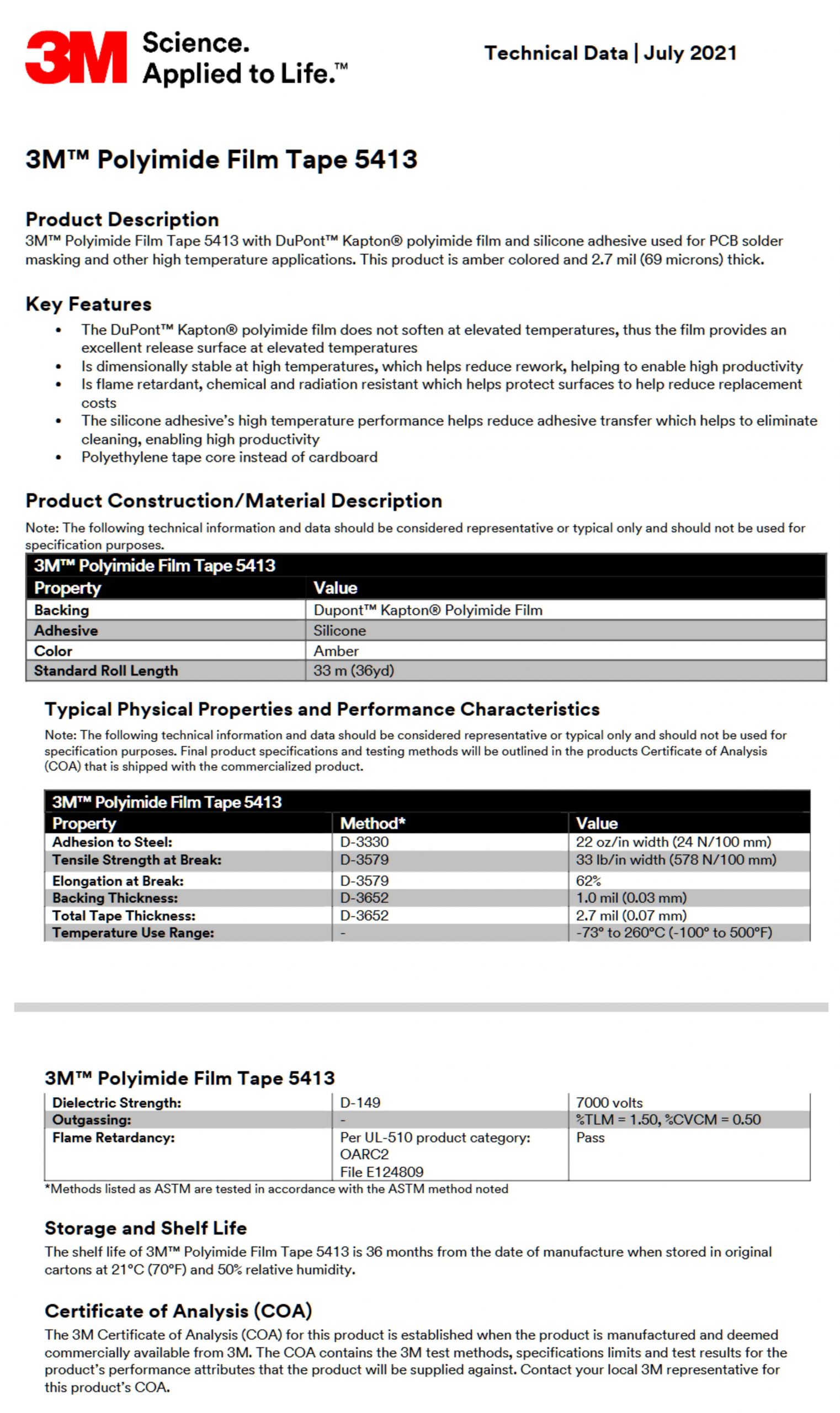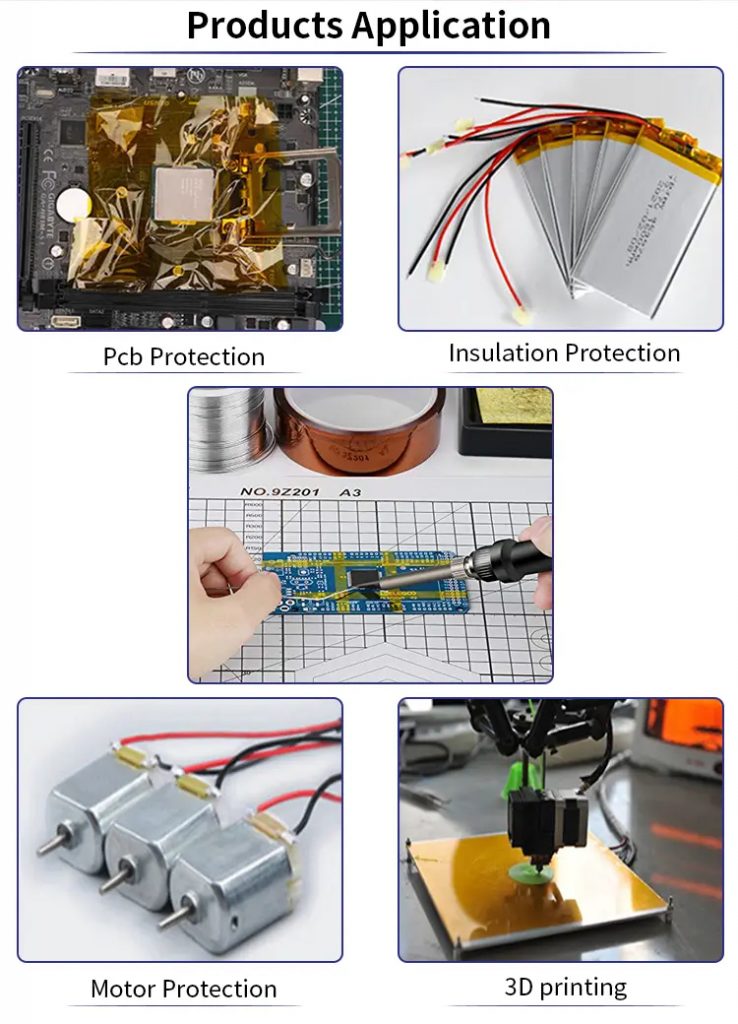
3M 5413 Polyimide Film Silicone Adhesive Tape provides insulation protection by combining a polyimide film backing with a silicone pressure-sensitive adhesive. Each component contributes different protective properties.
Here’s how it works:
Electrical insulation
The polyimide film is an excellent electrical insulator. It:
- Prevents unintended electrical contact between conductive parts.
- Helps reduce the risk of short circuits.
- Maintains its insulating properties over a wide temperature range.
This makes it useful for insulating components such as:
- Printed circuit boards (PCBs)
- Flexible circuits
- Transformer and motor windings
- Battery assemblies
- Semiconductor manufacturing fixtures
High-temperature protection
Polyimide is known for retaining its mechanical and electrical properties at elevated temperatures. The tape:
- Withstands temperatures encountered during soldering and electronics manufacturing.
- Resists shrinking, melting, or becoming brittle under typical process temperatures.
- Helps protect sensitive components during thermal processing.
Dielectric barrier
The film acts as a dielectric barrier, meaning it resists the flow of electrical current through the material. This allows it to separate conductors while minimizing electrical leakage under its rated operating conditions.
Chemical and environmental resistance
The polyimide backing is resistant to many:
- Oils
- Solvents
- Chemicals
This helps preserve its insulating performance in industrial and electronics manufacturing environments.
Silicone adhesive benefits
The silicone adhesive:
- Maintains adhesion across a broad temperature range.
- Performs well on difficult-to-bond surfaces.
- Leaves relatively little residue after removal in many high-temperature masking applications.
- Contributes to electrical insulation by covering exposed conductive areas, though the primary insulating function comes from the polyimide film.
Thin insulation layer
Because the tape is very thin, it can:
- Add electrical insulation without significantly increasing assembly thickness.
- Be used where space is limited, such as in compact electronic devices.
Typical applications
Common uses include:
- Wave solder masking
- Coil and transformer insulation
- PCB protection
- Battery pack insulation
- Electrical component wrapping
- High-temperature masking during manufacturing
Important considerations
While 3M 5413 is an effective electrical insulating tape, its protection depends on using it within its specified ratings. The tape’s dielectric strength, maximum continuous operating temperature, voltage rating, and environmental limitations are defined in the manufacturer’s technical data. It should not be used as the sole insulation system where safety standards require certified insulation barriers or reinforced insulation.
Typical workflow
- Clean the PCB surface.
- Apply the tape over the areas requiring protection.
- Press firmly to eliminate air bubbles and ensure full adhesion.
- Perform soldering, coating, or rework.
- Remove the tape after the assembly has cooled, pulling it back slowly at a low angle.
Common examples
- Protecting edge connectors (“gold fingers”) during wave soldering.
- Masking fine-pitch connectors before conformal coating.
- Shielding nearby ICs while replacing a surface-mount component with hot air.
- Holding a thermocouple in place during a reflow profile measurement.
Overall, 3M 5413 is considered a general-purpose, high-temperature masking tape for electronics manufacturing rather than a permanent PCB bonding material. It is primarily intended for temporary masking, insulation, and heat protection during fabrication and assembly processes.