Skip to content

Silicone-Based LED Strips (Why They’re Special)

Silicone LED strips usually mean silicone extrusion, silicone encapsulation, or silicone conformal coating instead of epoxy or PU.

Key Advantages of Silicone LED Strips

Superior Environmental Resistance

  • Excellent UV resistance (won’t yellow like epoxy)
  • Stable in outdoor, sun-exposed installations
  • Wide temperature range (typically -40°C to +150°C)

➡️ Ideal for: outdoor signage, architectural façades, marine, automotive

Long-Term Flexibility

  • Silicone stays soft and elastic over time
  • Does not crack or harden with age
  • Maintains bend radius even in cold weather

➡️ Critical for: curved channels, vibration-prone installs

Better Heat Tolerance

  • Silicone withstands higher operating temperatures
  • Less risk of delamination or cracking near LEDs
  • Improves lumen maintenance over time

➡️ Especially valuable for high-density or high-output strips

Excellent Waterproofing (IP67 / IP68)

  • Silicone seals remain stable over time
  • Better resistance to saltwater and chemicals than epoxy

➡️ Used in: pools, fountains, boats, industrial washdown areas

Optical Quality

  • Silicone diffusers provide:
    • Even light distribution
    • No yellowing haze
    • Stable color rendering over time

⚠️ Trade-Offs of Silicone LED Strips

Consideration

Notes

Cost

Higher than epoxy or PU

Adhesion

Silicone is hard to bond with standard tapes

Dirt attraction

Slightly tacky surface attracts dust

Cutting & sealing

Requires proper end caps or RTV silicone

Adhesion & Mounting (Important!)

Since silicone is notoriously low surface energy (LSE), you will need an adhesive that will work not only with LSE materials but silicone specifically. While there are tapes designed for LSE surfaces, the usually recommended tapes will disappoint since silicone is not only extremely low surface energy (~20–24 dynes/cm) there are other surface properties that make bonding to silicone rubber foam very challenging.

  • Mechanical mounting (aluminum channel) is best
  • RTV silicone
  • If tape is needed:
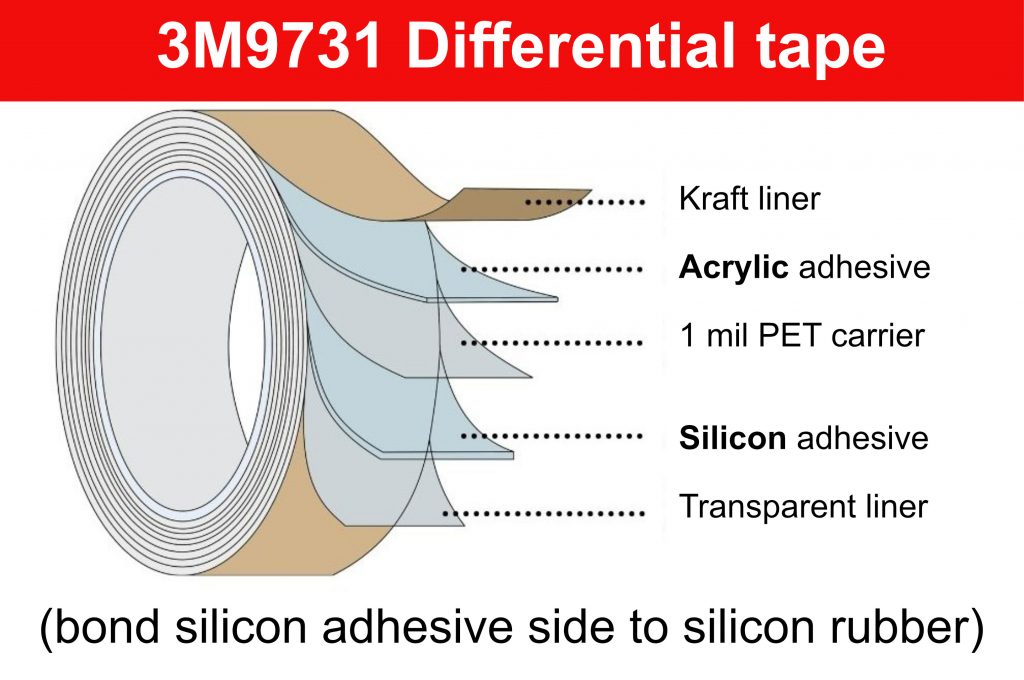
    • Silicone PSA like 3M 9731
      • Best when shear forces or lighter weight materials.

When Silicone LED Strips Make the Most Sense

Choose silicone-based LED strips if:

  • Outdoor or UV exposure is involved
  • Long service life matters (commercial installs)
  • Tight bends or vibration exist
  • Moisture, chemicals, or temperature extremes are present

If it’s indoor, dry, budget-driven → standard coated or bare PCB is often fine.

  1. Extremely low surface energy

Silicone’s surface energy is ~20–24 dynes/cm (very low).
Most adhesives want ≥38 dynes/cm to wet out properly.

➡️ Result: adhesives bead up instead of flowing and making intimate contact.

  1. Chemically inert surface

The Si–O backbone is very stable and non-reactive.
There are few functional groups for adhesives to chemically grab onto.

➡️ Result: weak physical adhesion only, no strong chemical bonds.

  1. Migration of silicone oils

Unreacted siloxanes and low-molecular-weight oils can slowly migrate to the surface.

➡️ Result: even if it sticks at first, the bond can degrade over time (classic “looks fine, then peels off”).

  1. High flexibility + elastic recovery

Silicone stretches a lot and snaps back aggressively.

➡️ Adhesives experience constant peel and shear stress, especially rigid or brittle ones.

  1. Thermal stability works against you

Silicone stays flexible from roughly –60°C to +200°C.

➡️ Many adhesives shrink, harden, or soften across that range—silicone doesn’t—so stresses build at the interface.

  1. Poor compatibility with common adhesives
  • Acrylic PSAs ❌
  • Rubber-based adhesives ❌
  • Hot melts ❌

They simply weren’t designed for silicone’s chemistry. 3M 9731 has been successfully used with silicone LED strips.