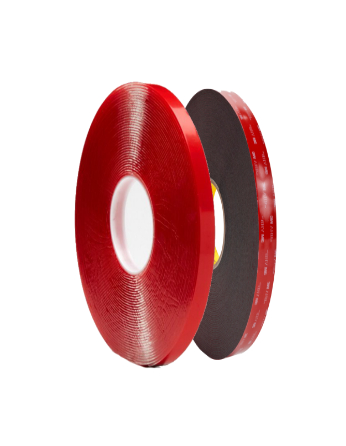
Before we talk about the best uses for acrylic foam tape, let’s take a look at what it is and what makes it different from other double-sided tapes.
Acrylic foam tape is also commonly associated with the term Very High Bond, or V-H-B, which is the trademarked name used by 3-M for its line of acrylic foam tapes.
3-M introduced V-H-B tape in 19-80 to address an industrial need: finding an effective pressure-sensitive adhesive that could replace welds and rivets in certain metal-to-metal bonding applications, including those exposed to harsh environments.
One of the early commercial applications involved bonding exterior panels to the structural frames of ambulances.
The idea was simple but effective. Unlike rigid mechanical fasteners, acrylic foam tape could accommodate some of the movement caused by temperature changes and the vibration and jarring experienced while a vehicle was on the road. This helped distribute stress across the bonded surfaces rather than concentrating it at individual fastening points.
As patents covering some of the foundational acrylic foam tape technology expired in the late 1990s and early 2000s, other pressure-sensitive adhesive manufacturers entered the market, introducing their own acrylic foam tapes under various trade names.
So, what exactly is acrylic foam tape?
Acrylic foam tape consists of a viscoelastic acrylic foam core with pressure-sensitive adhesive on both sides. The foam core and adhesive system work together to create a strong, durable bond.
Unlike conventional double-sided tapes that rely primarily on a relatively thin adhesive layer, acrylic foam tapes combine the adhesive with a resilient foam core that helps distribute stress across the bonded surfaces.
This construction is one of the reasons acrylic foam tapes can outperform many conventional double-sided foam tapes, such as polyethylene foam tapes, in demanding structural bonding applications.
Depending on the specific product and application, acrylic foam tapes can provide several important benefits:
- High bond strength
- Excellent long-term outdoor durability
- Resistance to moisture and UV exposure
- Vibration and impact damping
- The ability to accommodate thermal expansion and contraction
- A clean, nearly invisible bond line
That last benefit is especially useful when you want a strong bond without the visible appearance of screws, rivets, or other mechanical fasteners.
Because the foam core can absorb and distribute stress, acrylic foam tape can also help reduce localized stress concentrations that may occur around traditional fastening points.
So, where does acrylic foam tape make the most sense?
It’s often a good candidate for metal-to-metal bonding, exterior panels, trim, signage, and other assemblies that need a durable bond while experiencing vibration, temperature changes, or outdoor exposure.
Of course, the right tape depends on the specific application, including the materials being bonded, the loads involved, and the environmental conditions.
Now, one area where conventional acrylic foam tapes can struggle is bonding to low-surface-energy plastics.
Materials such as polyethylene and polypropylene can be difficult to bond because many conventional acrylic adhesives don’t wet out these surfaces sufficiently to develop a strong bond.
However, some newer acrylic foam tape formulations are designed to improve adhesion to these more challenging materials.
You’ll often see black acrylic foam tapes marketed for demanding bonding applications, including some low-surface-energy substrates. But don’t assume that a black foam core automatically means the tape is designed for those materials. Black can simply be an aesthetic choice.
Always check the product specifications or consult your tape supplier to confirm that the adhesive is suitable for the materials you’re bonding.
And one final recommendation: whenever possible, test the tape on your actual materials before committing to production.
Consider the surface condition, bond strength, temperature range, environmental exposure, and the type of stress the assembly will experience.
Acrylic foam tape can be an excellent alternative to mechanical fastening, but the best results come from matching the right tape to the application.
If you’re evaluating a tape for an industrial bonding project, visit QuickStickTapes.com and submit your project details. We can help you identify potential tape solutions for your application.