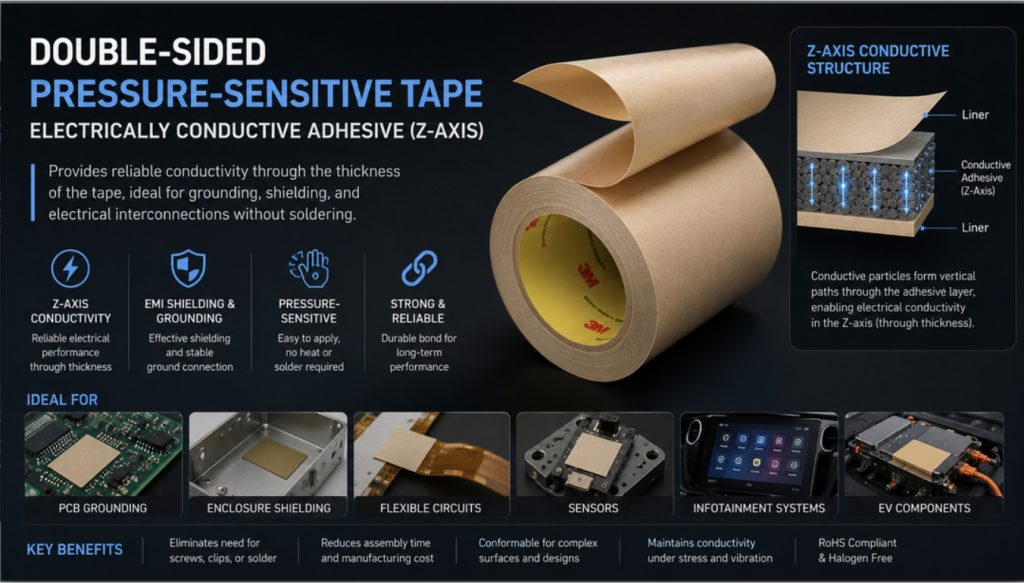
3M 9703 Conductive Adhesive Transfer Tape is an anisotropic conductive film (ACF) tape—meaning it conducts electricity through its thickness (Z-axis) but remains insulating in the X–Y plane. That makes it very useful for creating low-profile electrical connections without soldering.
Here are its main industrial applications:
Electronics & Interconnects
- Flexible printed circuits (FPC) to PCB bonding
Common in compact electronics where soldering is difficult or heat-sensitive. - LCD and display module connections
Used to connect driver circuits to glass or flex layers. - Shielding and grounding paths
Provides electrical grounding without bulky connectors.
Consumer Electronics Assembly
- Smartphones, tablets, wearables:
- Attaching touch panels, sensors, or flex cables
- Making fine-pitch connections in tight spaces
- Ideal where thin form factor + low heat processing is critical.
Prototyping & Low-Temp Assembly
- Solderless electrical connections for:
- Rapid prototyping
- Lab testing setups
- Works well when components cannot tolerate soldering temperatures
Automotive Electronics
- Used in:
- Dashboard displays
- Sensor modules
- Advantages:
- Handles vibration better than rigid solder joints
- Enables lightweight, compact assemblies
EMI Shielding & Grounding
- Creates electrical paths between conductive surfaces
- Used in:
- Enclosures
- Shielding layers
- Maintains isolation laterally while grounding vertically
Medical Devices
- In compact electronics like:
- Wearable monitors
- Diagnostic equipment
- Useful for:
- Miniaturized interconnects
- Gentle bonding (no thermal stress)
Key Advantages Driving These Uses
- No heat curing required (pressure-sensitive)
- Ultra-thin profile (~0.05 mm)
- Fine-pitch capability
- Reworkable (to a degree)
- Combines adhesion + conductivity in one step
3M 9703 Conductive Adhesive: Material Properties, Bonding Mechanisms, and Design Guidelines
Abstract
Anisotropic conductive adhesives (ACAs) have become critical in modern electronics manufacturing, enabling reliable electrical interconnections in compact and flexible assemblies. 3M 9703 conductive adhesive is a pressure-sensitive, z-axis conductive tape designed to provide electrical conductivity through the thickness while maintaining insulation in the x-y plane. This whitepaper examines its material composition, conductive mechanism, key performance properties, and practical design considerations for engineers integrating it into electronic systems.
1. Introduction
As electronic devices continue to shrink while increasing in complexity, traditional soldering and mechanical interconnect methods face limitations in flexibility, thermal stress, and manufacturability. Conductive adhesives—particularly anisotropic conductive films and tapes—offer an alternative solution.
3M 9703 conductive adhesive is widely used in applications such as:
- Flexible printed circuits (FPCs)
- Membrane switches
- EMI shielding and grounding
- Wearable and low-profile electronics
Its unique structure allows reliable electrical connections without shorting adjacent conductors, making it especially valuable in fine-pitch designs.
2. Material Composition and Structure
2.1 Base Adhesive Matrix
3M 9703 consists of a pressure-sensitive acrylic adhesive matrix. This matrix provides:
- Mechanical bonding strength
- Environmental resistance (humidity, temperature cycling)
- Conformability to uneven surfaces
2.2 Conductive Fillers
Embedded within the adhesive are conductive particles, typically metal-coated polymer spheres. These particles are:
- Dispersed uniformly throughout the adhesive
- Sized to enable controlled electrical संपर्क under الضغط
- Electrically inactive until compressed between conductive surfaces
3. Bonding Mechanism
3.1 Anisotropic Conductivity Principle
The defining feature of 3M 9703 is z-axis conductivity:
- Electrical conduction occurs only in the thickness (Z) direction
- No conduction occurs laterally (X-Y plane)
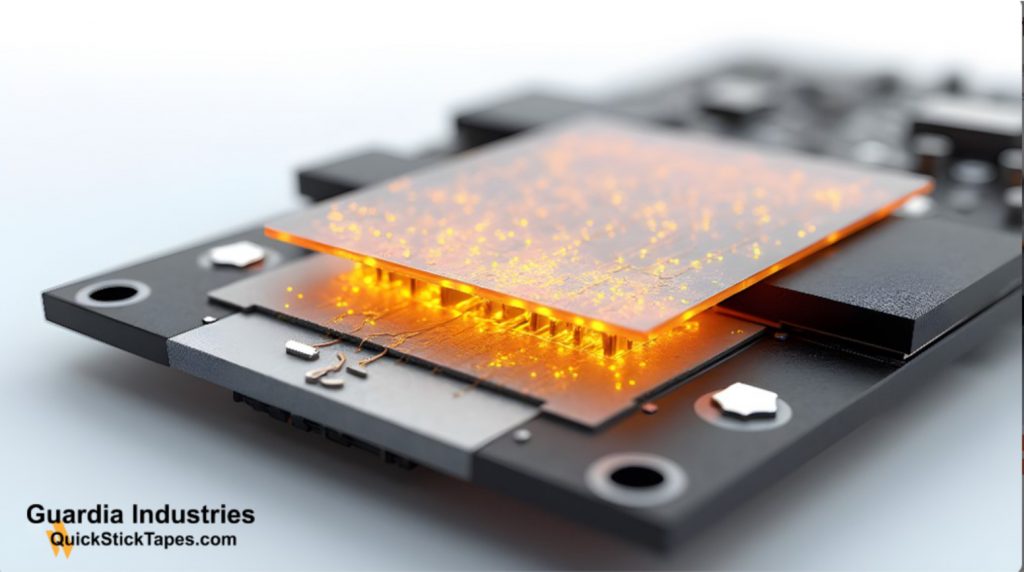
This behavior is achieved because conductive particles only form conductive pathways when compressed between two opposing conductive pads.
3.2 Contact Formation
When the adhesive is applied with pressure:
- Conductive particles are trapped between opposing conductive surfaces
- Mechanical الضغط causes deformation or compression
- Multiple संपर्क points form, creating a stable conductive path
3.3 Mechanical Bonding
Simultaneously, the acrylic adhesive forms a मजबूत bond with the substrate surfaces, ensuring:
- Mechanical stability
- Resistance to vibration and flexing
4. Key Material Properties
4.1 Electrical Properties
- Volume resistivity (Z-axis): Low when properly compressed
- Insulation resistance (X-Y plane): High, preventing shorts
- Contact resistance stability: Maintained under environmental stress
4.2 Mechanical Properties
- High peel and shear strength
- अच्छा flexibility for dynamic applications
- Suitable for thin and lightweight assemblies
4.3 Thermal Performance
- Operates across a moderate temperature range
- No reflow process required (unlike solder)
- Suitable for heat-sensitive components
4.4 Environmental Resistance
- Good resistance to humidity and oxidation
- Maintains performance under thermal cycling
- Long-term reliability in sealed systems
5. Design Guidelines
5.1 Surface Preparation
Proper surface preparation is critical:
- Clean surfaces to remove oils, dust, and contaminants
- Use compatible materials (e.g., copper, gold, silver inks)
- Avoid oxidation-prone surfaces without treatment
5.2 Contact Area and Pad Design
- Ensure sufficient pad area for reliable संपर्क
- Maintain proper spacing to leverage anisotropic properties
- Optimize pad geometry for uniform pressure distribution
5.3 Application Pressure
- Adequate pressure is essential to activate conductive pathways
- Insufficient pressure leads to high resistance or open circuits
- Excessive pressure may damage substrates or deform structures
5.4 तापमान and Environmental Conditions
- Apply within recommended temperature ranges
- Avoid extreme humidity during bonding
- Validate performance under expected operating conditions
5.5 Thickness and Tolerance
- Select appropriate adhesive thickness based on:
- Surface roughness
- Component tolerance stack-up
- Ensure consistent lamination during assembly
6. Advantages and Limitations
6.1 Advantages
- Enables fine-pitch interconnections without solder bridging
- Simplifies assembly (pressure בלבד, no curing required)
- Compatible with flexible and ताप-sensitive substrates
- Reduces thermal stress during manufacturing
6.2 Limitations
- संपर्क resistance depends on proper pressure and alignment
- Not suitable for high-current applications
- Requires controlled assembly processes for repeatability
7. Applications
Typical use cases include:
- Flex-to-board interconnections
- Membrane switch tail connections
- EMI shielding grounding points
- Wearable electronics and medical sensors
- Low-profile LED assemblies
8. Conclusion
3M 9703 conductive adhesive provides a reliable and scalable solution for modern electronic interconnect challenges. Its anisotropic conductive behavior enables high-density, low-profile designs while maintaining electrical isolation between adjacent conductors. By understanding its material properties and bonding mechanisms, engineers can effectively incorporate it into designs that demand flexibility, reliability, and manufacturing efficiency.
9. References
- Manufacturer technical datasheets
- Industry standards on conductive adhesives
- Application-specific validation studies